The plain HTML manifesto
Modern web stacks made pages easy to assemble and hard for a machine to read. We publish the document, and nothing else has to run before the words count.
Why JavaScript frameworks broke bot access
A framework page often answers a request with a shell. The sentences arrive later, after a program runs. Search engines can spend a second wave of crawling on that program. Many AI crawlers do not.
The cost is not theoretical. Unused CSS, a deep pile of divs, and links that are not links all sit between the bot and the fact. Crawl budget goes to the shell. The fact is late, or absent.
If a fact matters, it is in the HTML, visible, in heading order, and repeated in JSON-LD only when the page says the same thing.
GeoHTML
Why AI needs semantic structure
Large language models and retrieval systems split a page into chunks. A heading, a paragraph, a list item, and a table cell are chunks they already know how to name. A styled div is a box.
Semantic structure is not a decoration on top of a component. It is the API. h1 through h2 through h3, in that order, tells a model where a section starts. A table tells it which cells share a row. An a element with an href tells it where to go next.
Hiding the same text with CSS, or loading it when a control opens, trains the system to treat the page as incomplete. We do not do that with anything we want cited.
What we commit to
Every public GeoHTML page is a file a crawler can finish reading without a browser.
- Plain HTML for the words, with one h1 and no skipped heading levels
- Native CSS, with no framework and no web font unless a project forces the exception
- No essential text behind display:none, a client render, or an onclick link
- JSON-LD that matches the visible copy, including FAQs
- A translated counterpart at the same path under each locale prefix, tied with hreflang
- Source order that matches the order a person reads
This website is the specimen. The article hub shows the same rules used on a document, and the pricing page says what an engagement contains.
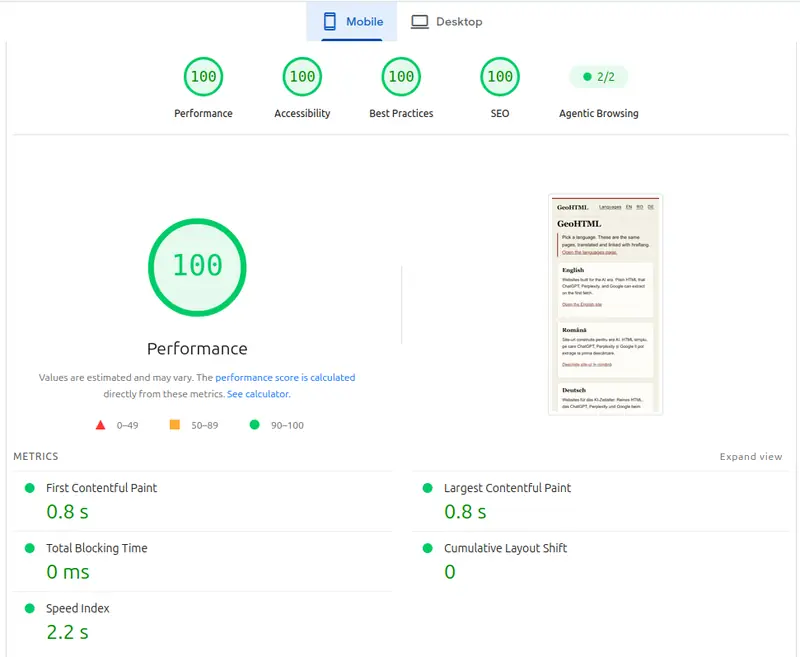
The Result of Zero Bloat: Perfect 100s
GeoHTML architectures natively achieve perfect 100/100 Google Lighthouse scores. Because we use zero JavaScript and plain HTML, there is 0ms of Total Blocking Time, resulting in instant rendering for both human users and AI Answer Engines.

Questions about the manifesto
Are you against JavaScript?
No. We are against requiring JavaScript before a public sentence can be read. Use a client where a task needs one. Do not use it to publish a paragraph.
Why not a popular framework with server rendering?
Server rendering can put text in the first response. It still tends to ship the framework, the hydration step, and a large CSS payload. We ship the document and a short stylesheet.
Request a free AI-extraction audit
Send one public URL. A person reads the HTML your server returns and writes back what AI crawlers can quote, and what they never see.